
My introduction to Craig Hospital – a world-renowned rehabilitation hospital specializing in spinal cord and traumatic brain injuries – occurred in 2017, when a neighbor asked Mrs. Snark and me if we would be interested in doing a charity bicycle ride called Pedal4Possible. We said yes and signed up to do a 35-mile bike ride which turned out to be really fun. Also on the ride were numerous Craig patients – most of them on recumbent, arm-pedal bikes – who were very inspirational.
Then in May of 2023, the daughters of a friend were involved in a terrible car accident in Virginia. The older daughter fell asleep at the wheel and the car went off the road and hit a couple trees. The driver fractured a femur and suffered a traumatic brain injury in the accident. Her sister fractured an arm and a couple ribs. The driver spent a month in a Virginia hospital before returning to Colorado where she spent a couple months at Craig Hospital to rehab from her injuries.
Being recently retired and searching for volunteering opportunities, I got the notion that maybe Craig would have a volunteer gig that might interest me. So, I went to their website and emailed the Volunteer Coordinator. She phoned me back and invited me down to the hospital to have a deeper discussion and to give me a tour of the facility. A month later, I was volunteering at Craig.
The hospital accommodates 93 in-patients and offers out-patient services as well. Each patient at Craig is assigned a team of doctors, nurses and therapists (physical, occupational, recreational, psychological and speech, if needed) and a very rigorous rehab program is prepared that is tailored to each patient’s specific needs.
The patients range in age from 15 to 70 and come from all over the U.S. The accidents that putpatients in Craig run the gamut from automobile, motorcycle, bicycle, skiing, swimming, falls, etc. The hospital also treats stroke victims.
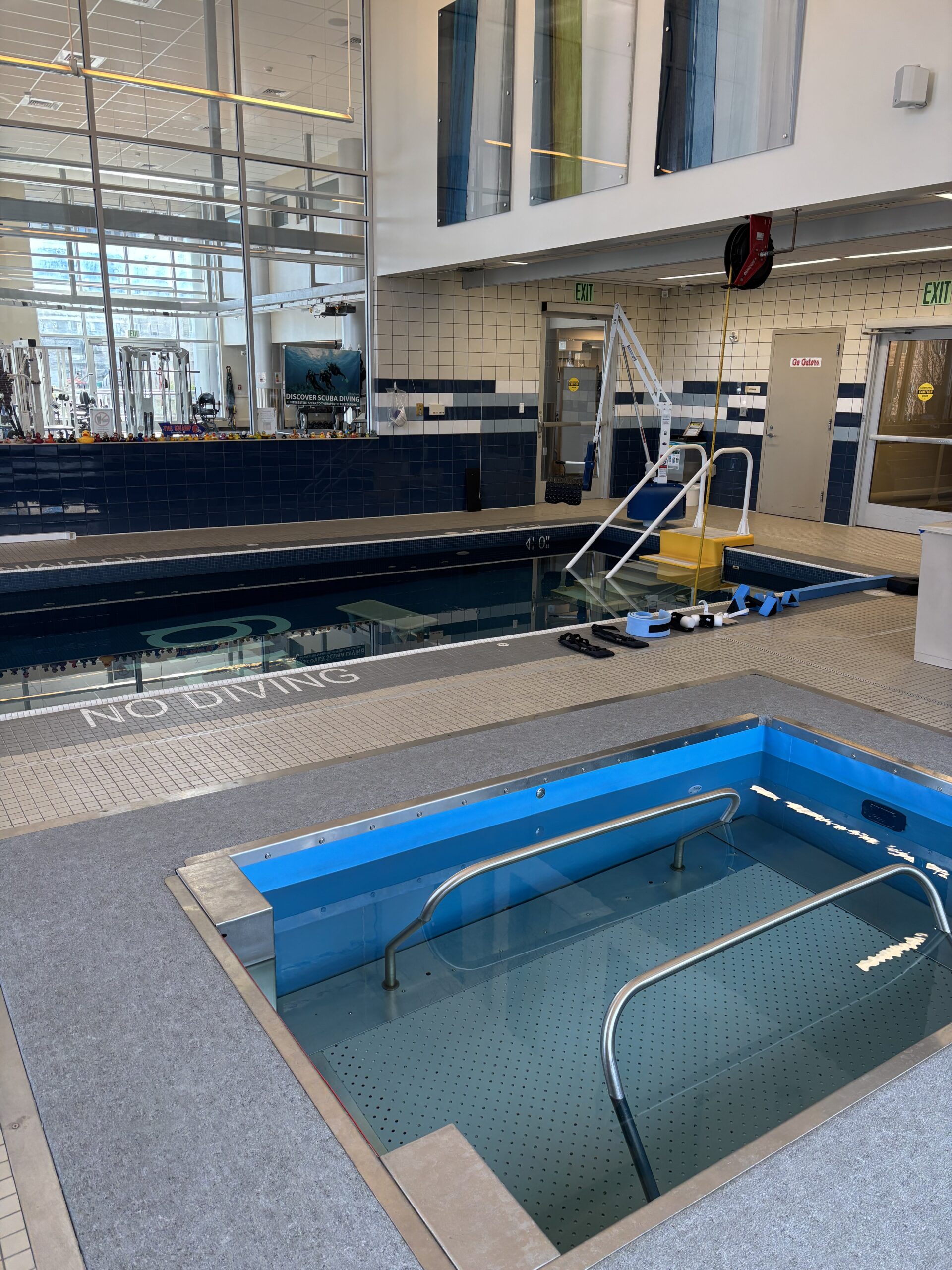
Adjacent to the main gym at Craig is a small pool and an underwater treadmill where the physical therapists (PTs) perform aquatic physical therapy on the patients and that’s where I volunteer. I stay on the pool deck and perform a variety of tasks: lowering and raising the patient in and out of the pool via a hydraulic chair or an overhead harness lift; shagging whatever equipment that the PT requires; placing water-resistant padding on the wheelchair; providing warm blankets and towels to the patient and PT when they exit the pool, etc.
Of all the rehab activities that the patients are put through at Craig, PT in the pool is the activity that the patients enjoy most. Most of the patients at Craig are in a wheelchair – so having the opportunity to get out of the wheelchair and experience weightlessness in the water is treasured by the patients. Most patients would go into the pool every day if they could, and most don’t want to get out of the pool either.
A year ago, one of my favorite patients – ChatterBox John – was in the pool for the first time, and his wife was on the pool deck sitting in a chair next to me. When ChatterBox was floating in the pool, a big smile emerged on his face. His wife said, “John, we’ve been in this hospital for 30 days and this is the first time that I’ve seen you smile since we’ve been here.” ChatterBox replied, “There are no words to accurately describe how wonderful it feels to be in this pool. It’s so liberating to be out of the wheelchair.” It’s a common reaction for a patient’s first time in the pool.
The water in the pool and treadmill is heated to 98 degrees by design – the warm temperature is very comfortable to the patient, allows for increased range of motion and reduces stress in their joints. The buoyancy and properties of water allow the patient to do PT exercises in the pool that are more difficult or impossible to do on dry land.
Once lowered into the pool, the PT will generally place a floaty collar around the patient’s neck and a pool noodle underneath their knees to keep the patient afloat. This also allows the PT to move the patient around the pool with a simple push or pull. The PT will then stretch out any muscles that are tight on the patient. She will usually have the patient do some core strengthening – abdominal crunches or leg lifts – and arm/leg exercises using foam dumbbells/ankle weights. Various walking/balance exercises are done if the patient is capable. Sometimes swimming or snorkeling is done.
The PT on my shift has been working in the Craig pool for 20+ years, and she’s one of the best PTs (pool or dry land) in the hospital. Her only downside … she’s a very proud University of Florida alum and an overzealous Gators fan. And yes, we do get snarky with each other sometimes but rarely with the patients … unless they deal the snark first and then it’s game-on.
In my two and a half years volunteering at Craig, I have witnessed some remarkable recoveries by the patients. On multiple occasions, I have lowered a patient into the pool using the hydraulic chair and watched the patient walk up the stairs to exit the pool – with no assistance.
In December, a patient had just completed a session on the underwater treadmill and said to me, “These people work miracles in this hospital. A month ago, I had no feeling or movement below my waist. Absolutely nothing. And now they have me walking on the treadmill. It’s crazy.” In response, I said, “Craig is a special place and the folks that work here are top-notch. It’s uplifting to witness some of the transformations that happen in this hospital – especially when a patient, like you, regains the ability to walk.”
My favorite quote from a Craig pool patient: “Craig Hospital is full of the nicest and most amazing people that you never want to meet.” Craig Hospital is not a place where you want to end up but thank God it exists … sometimes miracles happen there.